Tuesday, 24 January 2012

Top ten drinks trends for 2012

1. Real ale fans might blanch at the thought (and taste) of keg beer,   but craft keg is another beast altogether featuring boldly flavoured lagers,   IPAs and stouts from a new wave of technically savvy breweries such as   Camden, BrewDog and Lovibonds.
 2. Wine cocktails are nothing new even if Sangria is these days a bit   Benidorm — but ambitious mixologists looking for new frontiers of flavour   and with an eye on US bar trends would be mad not to carry out such   experiments as bourbon and Rioja or vodka and Chardonnay.


3. Here today, gone tomorrow is the philosophy behind the pop-up   restaurant so expect a wave of pop-up bars — North Bar in Leeds leads the   way already with Mr Frothy, an old ice cream van for hire whose chimes usher   in the promise of a pint rather than a choc ice.


4.The government’s increased tax on strong beer is a misguided attempt   to deal with binge drinking, but the accompanying introduction of lower   taxes on beers below 2.8% has led to flavoursome and weaker real ales from   the likes of Adnams, Greene King and Fuller’s.

5. ‘A pint of Martini’ might shake and stir the purists, but be ready   to hear these words more often when the American fondness for ready-made   cocktails served straight from the barrel lands in London.

6. Even though cider topped with handfuls of ice cubes is not such the   cool thing it was several years back, expect it to continue its upmarket   growth especially with an emphasis on single varietal and single orchard   ciders.

7. The sweet and fizzy Moscato d’Asti will keep defying the wine snobs   as drinkers seek something lighter that actually has some taste and also   goes very well with desserts such as lemon tart.

8. As hard times continue, home brew remains a popular pastime, but   it’s not just beer —several ground-breaking books such as Home Brew   (Pavilion) extend the idea of DIY tipple-making to wines, spirits and ciders.

9. Even though the rate is slowing, too many pubs are still closing —   however, so-called ‘craft beer bars’ such as Cask in London and Port Street   Beer House in Manchester will continue to open and thrive, as their young   hip clientele seek real ale and craft keg beers with the emphasis on   artisanal producers

10. Expect gin to keep shaking off its mother’s ruin image, especially   as a new wave of micro distilleries such as London-based Sipsmith continue   to push boundaries and add interesting botanicals.

Sourced from The Telegraph


Food symbolism: Why do we give food meaning?

BBC News

Dishes eaten at Chinese New Year carry great significance, as does the way a Burns Night supper is presented. But these are not the only meals which represent something to diners and the reasons we attach meaning are as myriad as the food itself.


It seems odd that a small parcel of tasty filling encased in a light dough wrapper can represent so much.

But the jiaozi dumpling symbolises prosperity to diners, who traditionally sit down for a family feast on the eve of Chinese New Year. It also means wealth when the dumpling is crescent shaped, like the gold ingot once used in ancient China as money.

Chinese chef Ching-He Huang says the centuries-old "lucky" food traditions come from superstitions about feeding the spiritual world, legends and history.

"For example, the bamboo glutinous rice, zongzi, was eaten to commemorate a famed poet. These rice dumplings were thrown in a river so the fish would feed on the rice instead of his corpse, because he threw himself into the river and he was a well-loved poet and patriot of the people," she says.

Fuchsia Dunlop, BBC journalist and author of the Revolutionary Chinese Cookbook, says many of the meanings given to Chinese food are homophones of their names in Mandarin.

Read full article at BBC

Sourced from By Anna-Louise Taylor

25 Facts about McDonalds

1. Each day, 1 in 4 Americans visits a fast food restaurant


2. In 1972, we spent 3 billion a year on fast food - today we spend more than $110 billion


3. McDonald's feeds more than 46 million people a day - more than the entire population of Spain


4. French fries are the most eaten vegetable in America


5. You would have to walk for seven hours straight to burn off a Super Sized Coke, fry and Big Mac


6. In the U.S., we eat more than 1,000,000 animals an hour


7. 60 percent of all Americans are either overweight or obese


8. One in every three children born in the year 2000 will develop diabetes in their lifetime


9. Left unabated, obesity will surpass smoking as the leading cause of preventable death in America


10. Obesity has been linked to: Hypertension, Coronary Heart Disease, Adult Onset Diabetes, Stroke, Gall Bladder Disease, Osteoarthritis, Sleep Apnea, Respiratory Problems, Endometrial, Breast, Prostate and Colon Cancers, Dyslipidemia, steatohepatitis, insulin resistance, breathlessness, Asthma, Hyperuricaemia, reproductive hormone abnormalities, polycystic ovarian syndrome, impaired fertility and lower back pain


11. The average child sees 10,000 TV advertisements per year


12. Only seven items on McDonald's entire menu contain no sugar


13. Willard Scott was the first Ronald McDonald - he was fired for being too fat


14. McDonald's distributes more toys per year than Toys-R-Us


15. Diabetes will cut 17-27 years off your life


16. McDonald's: "Any processing our foods undergo make them more dangerous than unprocessed foods"


17. The World Health Organization has declared obesity a global epidemic


18. Eating fast food may be dangerous to your health


19. McDonald's calls people who eat a lot of their food "heavy users"


20. McDonald's operates more than 30,000 restaurants in more then 100 countries on 6 continents


21. Before most children can speak they can recognize McDonald's


22. Surgeon General David Satcher: "Fast food is a major contributor to the obesity epidemic"


23. Most nutritionists recommend not eating fast food more than once a month


24. 40 percent of American meals are eaten outside the home


25. McDonald's represents 43% of total U.S. fast food market


Sourced from  Fast food facts from the Super Size Me Web site

The future of food

By 2050 there will be another 2.5 billion people on the planet. How to feed them? Science's answer: a diet of algae, insects and meat grown in a lab

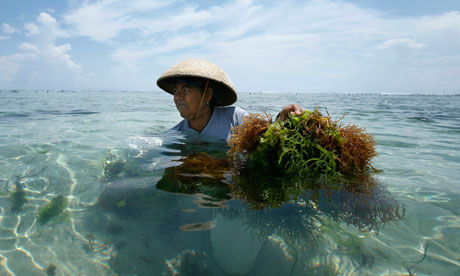
seaweed harvesting in Bali
Seaweed harvesting in Bali. From seaweed to slime, algae is the future of food, says Professor Mark Edwards Photograph: Ed Wray/AP


How can we feed the 2.5 billion more people – an extra China and India – likely to be alive in 2050? The UN says we will have to nearly double our food production and governments say we should adopt new technologies and avoid waste, but however you cut it, there are already one billion chronically hungry people, there's little more virgin land to open up, climate change will only make farming harder to grow food in most places, the oceans are overfished, and much of the world faces growing water shortages.

Fifty years ago, when the world's population was around half what it is now, the answer to looming famines  was "the green revolution" – a massive increase in the use of hybrid seeds and chemical fertilisers. It worked, but at a great ecological price. We  grow nearly twice as much food as we did just a generation ago, but we use three times as much water from rivers and underground supplies.

Food, farm and water technologists will have to find new ways to grow more crops in places that until now were hard or impossible to farm. It may need a total rethink over how we use land and water. So enter a new generation of radical farmers, novel foods and bright ideas.

Read full article at The Guardian

The signs aren't good for Tesco. What's to be done?

There was nowhere to hide for Tesco CEO Philip Clarke this week, after the worst Christmas results in 20 years. Bottom of the class, Tesco’s 2.3% year-on-year decline in like-for-likes shocked the City, as even house brokers downgraded their profit estimates.
Clarke was forthright in his assessment of Tesco’s “long-standing issues”, and he announced it would pour hundreds of millions into a 12-month programme to get its UK operation back on track.
And the ramifications will be felt far beyond retail, with the construction industry sure to suffer as Tesco slams the brakes on its relentless UK store rollout, something Clarke ruled out strongly as recently as October. “We’ll see more stores,” said Clarke, but there will be few to no more Extras. The focus will switch to online.
Internet sales grew by 14% over Christmas and Tesco’s plans this year include further expansion of its click and collect service, opening more dark stores and the launch of an online marketplace to rival eBay.
Tesco’s version of a crisis is one that any other retailer would die for, but Clarke’s admissions were nevertheless unheard of, with the success of the group in areas such as Asia and the US completely overshadowed, as Tesco’s UK share in the last year slipped from 30.5% to 30.1% despite its huge investment in extra space [Kantar 12 w/e 25 December 2011]. And the 2010 figure, in itself, represents a decline on five years ago (see table).

Read the full article at The Grocer

Sunday, 8 January 2012

Eden Project to hold first World Pasty Championships

Cornish pasty

Judges will be looking for the best Cornish pasty made to the traditional recipe


Cooks from around the world will head to Cornwall in March for the first World Pasty Championships.

The event will be held at the Eden Project, St Austell, to celebrate the popular local delicacy, which was given protected status under EU law earlier in 2011.

The Cornish Pasty Association, which is backing the event, hopes people locally and across the world will take part.

It will be held on 3 March, the Saturday before St Piran's Day.

The Cornish pasty has been associated with tin miners in the county, and was a part of many people's diets during the 18th Century.

The Oxford English Dictionary suggests the pasty was first identified around 1300.

'Original fast food'

Families in Cornwall have passed down the recipe for a Cornish pasty through the generations.

Phil Ugalde of the Cornish Pasty Association said: "If you know anything about Cornwall, you know that pasty-making is a very emotive subject.

Read full article available at BBC

Eating Christmas trees at the 'world's best restaurant'


 On board Rene Redzepi's houseboat food lab


Rene Redzepi is the Willy Wonka of food science, conducting gastronomic experiments so popular that customers fly round the world to eat at his £150-a-head Copenhagen restaurant.


If you have just thrown out your Christmas tree, may I make a suggestion? Next year don't dump it, burn it or shred it - just eat it.

Believe me, the needles from your average Christmas fir can be delicious.

How do I know? Well I am just back from the most extraordinary gastronomic journey of my life - the citrusy tang of freeze dried Christmas tree was just one of the surprises along the way.

My guide was Rene Redzepi, a bearded 34-year-old chef with intense brown eyes whose Copenhagen restaurant Noma is currently regarded by food critics as the world's finest.

Actually, to his worldwide legion of gastronomic disciples, labelling Redzepi as a cook is akin to defining Michelangelo as a jobbing painter and decorator.


From humble beginnings - he left school at 15 with no qualifications - Redzepi has developed a philosophy of food which embraces science, nature and art.

I met him in the teeth of a biting wind on a bleak quayside in the Danish capital. Rene's restaurant occupies the end of an old warehouse overlooking the water - but that was not our first destination.

Link here to read BBC article

Saturday, 7 January 2012

Groceries 'cheaper' now than in 1862, Grocer magazine finds

Groceries today cost one-thirteenth of what they did 150 years ago, according to a study from The Grocer magazine.


The magazine applied an inflation measure to the 1862 prices of 33 items including eggs, hot chocolate, bread, grapes, a toothbrush and sherry.

The weekly basket of food, drink and household items priced at £93.95 now would have cost an 1862 shopper £1,254.17 in real terms.

The magazine put the fall down to wage increases and greater imports.

The Grocer carried out the analysis to mark its 150th birthday.

While a Victorian shopper would spend a third of their money on food - today our grocery shop accounts for less than 10% of our weekly expense, it said.

It found the biggest relative changes were seen in non-native fruits.

This week a pineapple cost an average of £1.72 but in 1862 it sold for 5s - estimated to cost £149 in real terms.

Link to full BBC article

Wednesday, 4 January 2012

Families encouraged to eat healthily on the cheap

An effort to convince families in England that they can eat healthily on a budget is being launched.


Four million recipe leaflets will be mailed to families already signed up to the government's Change 4 Life public health campaign.

Three supermarket chains have also agreed to offer discounts on products such as fruit, vegetables and fish.

But Labour said ministers do not take public health seriously and the drive is an "advertisement for big business".

Meanwhile, celebrity chef Ainsley Harriott has helped devise a cookbook promoting healthy dishes, with recipes that can be created for under £5.

He has also been filmed performing cooking tutorials which will be posted on the Change 4 Life website.

Read full article BBC