


Princes buys canned foods brands
Growth of the 'big four' supermarkets
Supermarkets on employment drive
Has Tesco got too much power?
Waitrose plans to mix with the discounters
Tesco trails after new discount offers backfire
Sainsbury's boost over Christmas
Food and Energy Security Go Hand in Hand, Says UN Agency
Morrisons to create 5,000 new jobs
10 Fascinating Food Facts
Food and Energy Security Go Hand in Hand, Says UN Agency
Food and Energy Security Go Hand in Hand, Says UN Agency
Growing up, most of us ate leftovers at home. Now, the United Nations wants farmers to take advantage of leftovers, too, by using energy-generating discarded rice husks and other farming byproducts to power additional farming activities. The move could help farmers in the developing world sustain their livelihoods, as well as better prepare for climate change. The report, titled "Making Integrated Food-Energy Systems (IFES) Work for People and Climate - An Overview," presents a winning formula to put farmers in developing countries ahead of the curve in climate-adaptation strategies."By combining food and energy production, IFES reduce the likelihood that land will be converted from food to energy production, since one needs less land to produce food and energy," says the report.
Harvesting food and energy-producing crops offers an innovative, sustainable way forward for a majority of the developing world, since food security, energy, and climate change are such grave concerns at this point in time--and are not expected to lessen any time soon. The key is to scale up models that are already working and reproduce them elsewhere in the world.
In the Democratic Republic of the Congo, for example, farmers are growing cassava and acacia, from which the wood is then used for charcoal. And those farmers earn four times as much as taxi drivers. In Vietnam, farmers combine livestock, crop, and fish production that together generate biogas, which the farmers then use as a low-cost cooking fuel.
“With these integrated systems farmers can save money because they don’t have to buy costly fossil fuel, nor chemical fertilizer if they use the slurry from biogas production," said FAO Assistant Director-General for Natural Resources, Alexander Müller. "They can then use the savings to buy necessary inputs to increase agricultural productivity, such as seeds adapted to changing climatic conditions--an important factor given that a significant increase in food production in the next decades will have to be carried out under conditions of climate change. All this increases their resilience, hence their capacity to adapt to climate change."
Women in particular benefit from the IFES approach, as they are no longer forced to leave their crops for extended periods of time in search of firewood. There are health benefits of switching to IFES, as well--1.9 million people die every year from stove-top smoke-related complications; switching to alternative energy sources, says the report, will help decrease those deaths.
Sourced from Fast Company
Princes buys canned foods brands
Princes buys canned foods brands
(UKPA) – 1 day agoHousehold brands Crosse & Blackwell and Fray Bentos have been snapped up by food and drinks group Princes in a deal worth £182 million.
Their acquisition forms part of an agreement with Premier Foods for its canned grocery operation, including factories at Long Sutton in Lincolnshire and Wisbech in Cambridgeshire which employ more than 1,000 people.
Liverpool-based Princes has also secured a long-term licence to make products such as baked beans and pasta in cans under the Branston and Batchelors brands.
The sale, which is subject to a number of conditions, comes less than a month after Premier offloaded its meat-free business Quorn for £205 million in a drive to lower its debt mountain, which stood at £1.4 billion in June. It will also enable the company to focus on key brands such as Hovis and Mr Kipling.
Princes, which has grown from being an importer of canned fish into a supplier of products ranging from fruit juice and canned meat to microwave meals and sandwich spreads, will have annual revenues of £1.5 billion following the deal. It will also have 13 production sites and a 4,500-strong workforce.
As well as Crosse & Blackwell and Fray Bentos, Premier is also selling the brands Farrows and Smedley's.
Premier's East Anglian canned grocery operation achieved sales in the region of £334 million and underlying earnings of £32 million in 2010.
The disposal excludes Premier Foods' Ambrosia branded canned desserts operations in Lifton, Devon, which is being retained.
Premier's chief executive, Robert Schofield, said: "Selling the business simplifies our operations and allows us to concentrate our efforts on our current portfolio of great British brands."
The deal also improves Premier's earnings to debt ratio - a key measure in the City - after an acquisition spree in recent years that has included Hovis owner RHM and Campbell's Soup in the UK and Ireland.
Copyright © 2011 The Press Association. All rights reserved.

Source: Today I Found Out
Growth of the 'big four' supermarkets
Growth of the 'big four' supermarkets
 Fears have been voiced about the growth of the 'big four' supermarkets after BBC research found at least 577 stores were approved in the UK in two years.
In Scotland at least 67 stores were approved and there were at least 22 in Wales and eight in Northern Ireland.
Campaigners say the stores are putting independent traders out of business.
The supermarkets insist they carefully consider where they build new stores, adding that their developments create jobs and help regenerate towns and cities.
'Bad for character'
Despite the number of stores approved, the British Retail Consortium, which represents the big four, said the current rate of growth was lower than that seen earlier in the decade.
And the Usdaw union, which represents many supermarket employees, said the companies were providing crucial jobs during tough economic times.
Hugh Fearnley-Whittingstall and the the British Retail Consortium's Stephen Robertson on the big four

But the Farmers For Action (FFA) campaign group said it feared competitive discounting and the way supermarkets traded with food producers would eventually "put British agriculture out of business".
Meanwhile campaigner Jessie Miller, who is fighting plans for a new supermarket in Oswestry, Shropshire, said the increase in stores was "bad for the character of our country" because it left high streets unable to compete.
Others have criticised the UK's planning laws, alleging supermarkets are able to exploit them for their own gain, without consulting local communities.
John Walker, national chairman for the Federation of Small Businesses, said the number of stores which had opened in the UK in two years was "a concern", especially when almost 12,000 independent shops closed their doors in 2009.
However he added that in some areas supermarkets could give towns a boost, attracting more people to the area that may then also use high street shops.
In order to gauge the rate of expansion of the major supermarkets, the BBC contacted planning authorities across the UK to find out how many new stores had been approved between 1 November 2008 and 1 November 2010.

Not all councils responded, but out of those that did Tesco proved to have had the most successful applications with at least 392 stores approved, followed by Sainsbury's at 111, Morrisons with 41 and Asda at 33.
In England, London had the highest number of proposed new supermarkets with 110, followed by the North West with 63.A BBC Panorama special programme called Supermarkets: What price cheap food? will be broadcast on BBC One at 2100 GMT on Wednesday and will also investigate the growth of supermarkets.
Chef and food campaigner Hugh Fearnley-Whittingstall told the programme: "Such is the power of the supermarkets, they are effectively rearranging the entire landscape to suit their business practices.
"You don't need to explain the attraction of cheap food, everybody likes saving money, but the effect of that simple drive to bring down price - it's massively altering the way we produce food, the scale on which we produce food."
'Incomplete and misleading'
FFA chairman David Handley said the British agricultural industry had been in decline for the past 10 years because of the low prices supermarkets paid to farmers.
He said: "They need to be looking at the way they trade, the way they will continue to trade as they get bigger and bigger.
"If they continue the way they are trading at the moment they are going to put British agriculture out of business," he said.
 About 450 people paraded through Oswestry in March to campaign against plans for a supermarket
Ms Miller, the group's secretary, said she was concerned that supermarkets were "just filling in their map" and not caring about what towns needed or wanted.
"We are are seeing more and more supermarkets and the high street just cannot compete," she said.
Responding to the BBC's research, Tesco said in a statement: "The BBC figures are incomplete and misleading.
"Most of our new store applications are not for large supermarkets but for small, local convenience stores, the likes of which millions of customers have relied on to get food in the bad weather.
"Neither do the BBC's figures take into account shops that have closed.
'13,000 new jobs'
"We always put customers first and we have invested in the UK even during the worst recession in living memory, creating tens of thousands of jobs, many in the most deprived areas of the country."
A Morrisons spokesperson said: "Morrisons is different from other supermarkets. We are the only one to own much of our own supply chain including meat processing and produce packing.
.jpg)
Asda said that of the big four it had "far fewer stores than anyone else" but it added in terms of sales it was still the second largest.
It said: "Because some parts of the country are dominated by others, we tend to find communities love the idea of an Asda to give them real choice with the lowest prices and ranges such as George."
And Sainsbury's said: "Sainsbury's current expansion plans are based on sound commercial judgements about what is best for our business and our customers in the next five years.
"We take great care to identify the right opportunities to build new stores and extend existing ones.
"Most of our new stores (75%) are being built in areas where we are currently under-represented like the north west of England and Scotland, for example.
"We will have created 13,000 new jobs around the country in two years by March 2011."
BBC Panorama's Supermarkets: What price cheap food? will air on BBC One at 2100 GMT and will be available on BBC iPlayer. Sourced from the BBC
Supermarkets on employment drive
Supermarkets on employment drive
As the Supermarkets go from strength to strength will this have an effect on the downturn. The supermarket go on a big employment drive will this take the sting out of the recession.But this growth in the supermarkets will have a down side, if the supermarkets continue to open new stores (small and large) then the smaller local produce shops will disappear even more than ever.
New jobs created
[caption id="" align="alignleft" width="142" caption="Iceland created 2,500 Jobs"]
 [/caption]
[caption id="" align="alignleft" width="142" caption="Waitrose create 4,000 new jobs"]
 [/caption]
[caption id="" align="alignleft" width="142" caption="Sainsbury's create 5,000 new jobs"]
 [/caption]
[caption id="" align="alignleft" width="142" caption="Tesco create up to 10,000 new jobs"]
 [/caption]
[caption id="" align="alignleft" width="110" caption="Creating up to 5,000 new jobs"] [/caption]
Seasonal Produce
I work for a food manufacture. I think we should start buying seasonal produce, this will halp local producers and local growers. local produce. Why should we be able to buy strawberry's in December, we buy so much food from around the world, do we care about who and how our food is manufactured.
[polldaddy poll="1283004"]
Morrisons to create 5,000 new jobs
Morrisons to create 5,000 new jobs
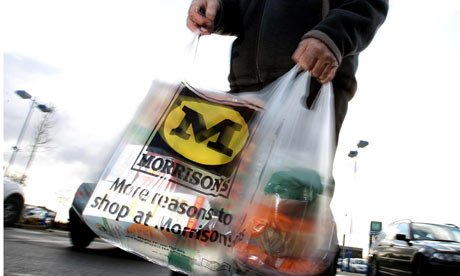
A Morrisons customer in Tynemouth. The company wants to add 90,000 sq metres of store space in coming years Photograph: Owen Humphreys/PA
Morrisons has pledged to create 5,000 jobs this year, bucking the rise in unemployment as it looks to grow despite the economic downturn.
Britain's fourth-largest supermarket group said this morning that it would create new positions across its chain of stores. The new roles will include working on Morrisons' butchery, fish and bakery counters, said the personnel director, Norman Pickavance, although full details were not available.
"Even in these challenging economic conditions, Morrisons is committed to hiring and training new people to keep retail as the engine room of the economy and support our continuing growth," Pickavance said.
sourced from The Guardian
Tesco trails after new discount offers backfire
One of the largest supermarket changes in Britain "Tesco" has suffered over the Christmas period. It was the worse performing on the top four supermarkets. This article is in direct contrast to Sainsbury's bumper Christmas sales.
The Article
Tesco will this week report the weakest Christmas trading of the big four supermarkets as doubts set in over its ambition to become "Britain's biggest discounter".
Analysts expect Tesco to post a 2.5% increase in like-for-like sales, lagging behind a field led by Morrisons, with an estimated 9%, nearly 7% at Asda and 4.5% at Sainsbury's.
Last year Tesco introduced a range of discount brands such as "Country Barn" cornflakes and "Daisy" washing up liquid to compete with Aldi and Asda. Analysts fear that the cheaper brands cannibalise sales: because these brands cost less, Tesco must sell more to stand still.
"This is the first big mistake Tesco has made in a decade," said Planet Retail analyst Bryan Roberts.
The supermarkets fared better than non-food specialists during a tough holiday season for the retail sector with results from specialists such as Currys and Argos, also due on Thursday, expected to make grim reading as consumers deferred spending on non-essential items. Tesco chief executive Sir Terry Leahy will say that consumers let go of the purse strings to buy "special" Christmas treats for their families.
read full article sourced from The Observer
Sainsbury's boost over Christmas
Sainsbury's boost over Christmas
As recession is looming nearer. Sainsbury's has had a good Christmas and is creating 5,000 near jobs this year.Sainsbury's served a recorded 22.5 million customers
Supermarket to employ 5,000 extra staff
A record-breaking Christmas is helping Sainsbury's to create 5,000 jobs this year.
The supermarket - which already employs 150,000 - had its best ever festive season with sales for the last three months of the year up 4.5 per cent on the same period in 2007.
The group hired 20,000 temps to help cope with the surge in trade - 8,000 more than originally planned. read more
Waitrose plans to mix with the discounters
Waitrose plans to mix with the discounters
Waitrose is rebranding 1,450 own-label products and cutting prices on 450 lines in a bid to stop increasingly cost-conscious shoppers from defecting to rival supermarkets to find cheaper alternatives.A new Essential Waitrose label goes into the chain's 220 stores this week, starting with meat, fruit and vegetables. Prices on a third of the range will be slashed by up to 25%, at a cost of £25m.
Waitrose chief executive Mark Price described the new strategy as "the biggest decision and the biggest launch in the history of Waitrose" and an attempt to "totally reposition" the middle-class brand.
"The perception of our customers is that we are 25% more expensive than Tesco or Sainsbury. We know that is not the case – we match 2,500 products against Sainsbury's prices, but we haven't been able to get people to believe that. Hopefully now they will."
A big promotional campaign to promote the new ranges is planned for TV.
Of the 1,450 brands involved, which represent 15% of Waitrose's £4bn of annual sales, 1,200 are existing products that have been given a new look. The balance are new lines, such as standard-priced cakes and multi-packs of yoghurts that Waitrose has not previously stocked but that it has discovered shoppers go elsewhere to buy.
Waitrose has been losing market share, although Price said they were not losing customers. The problem, he said, was that they are buying fewer products – and picking up bargain staples at rivals.
All the supermarkets have reported big increases in sales of value and basic ranges, while premium labels, like Tesco's Finest and organics, are now in decline. The "hard discounters", including Aldi and Lidl, are now the UK's fastest-growing grocers.
The Waitrose initiative was unveiled as its parent group, John Lewis, revealed another tough week of trading.
Sales at the department store chain in the last week of February were down 10% on the same week last year, with fashion and homewares particularly weak, recording declines of 9% and 18% respectively. The group said the later timing of Easter this year was partially to blame.
"Although John Lewis advanced some mitigating factors, the underlying trend in their sales has clearly deteriorated in recent weeks," said Howard Archer at IHS Global Insight.
The last seven days are unlikely to have been much better as Debenhams and House of Fraser have been holding mid-season sales offering up to 25% off and as a result of its never-knowingly-undersold promise John Lewis has been forced to match prices on branded goods.
sourced from The Guardian
Has Tesco got too much power?
Has Tesco got too much power?
sourced from The Today Programme BBC Radio 4


No comments:
Post a Comment